ATS page or own careers site? Why standard often disappoints
An RPO partner implementing an ATS almost always gets a website module with it. Using it is the obvious choice. It saves a supplier, an integration and part of the project plan. We often see what happens next: after a few months the client is unhappy with inflow, and the RPO team gets blamed for something that goes wrong at the front end. That is a pity, because it is easy to fix. This article belongs to our guide for RPO partners.
What an ATS is built for
An ATS organises the process: creating vacancies, receiving applications, assessing candidates, planning interviews and reporting. The website module is an offshoot of that. It lists vacancies and captures applications. A careers site has to do more. It has to persuade candidates who are still hesitating, tell the employer story, catch campaigns and show where visitors drop off.
Where the difference lies
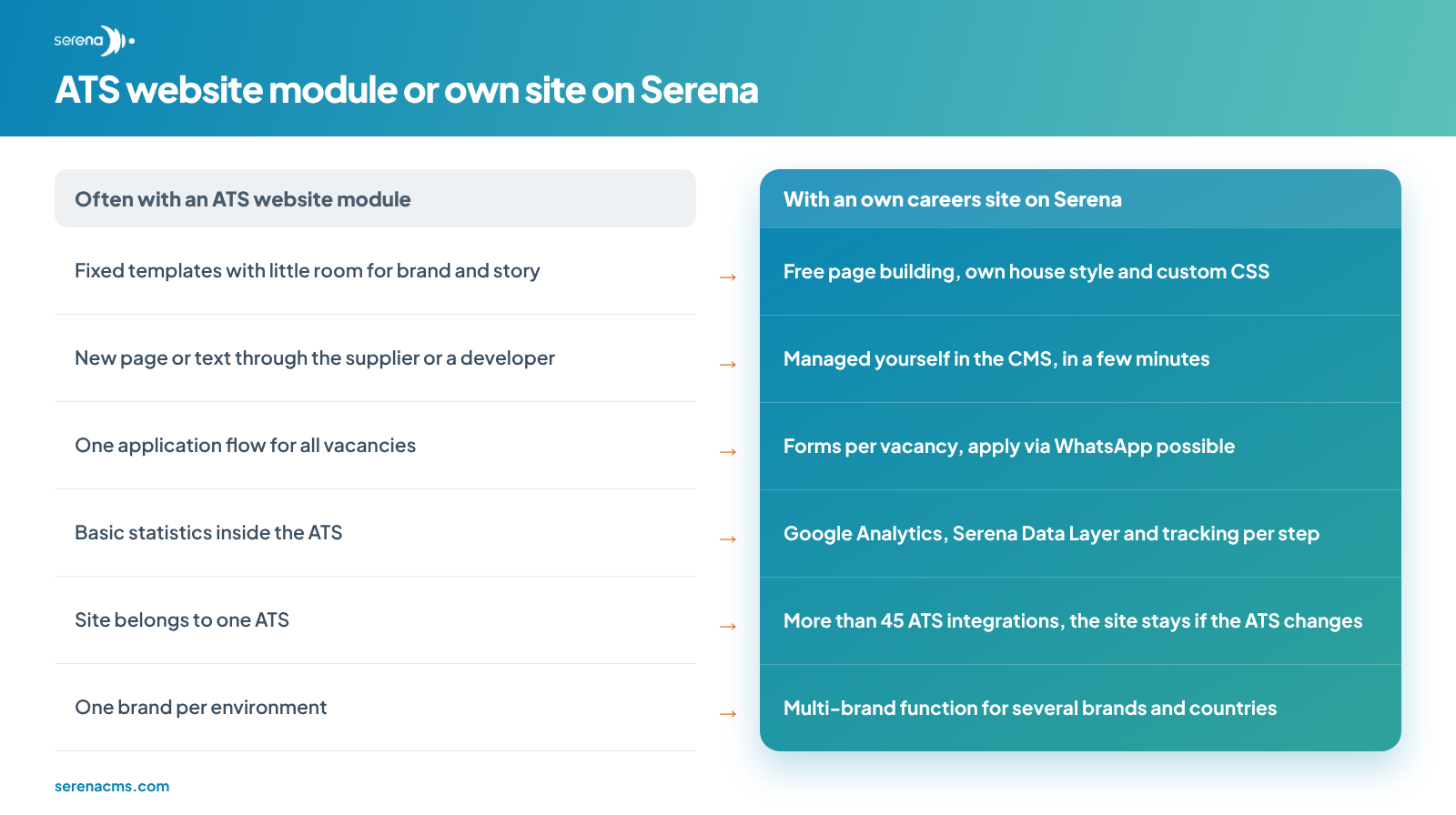
Industry articles keep naming the same bottlenecks. Shazamme writes about slow content updates, rigid application flows, inconsistent branding, weak integrations and limited analytics. JobTrain points to the hand-off from site to ATS, where extra clicks, a different look and a weak mobile experience cost candidates.
WelThuis: from Careers Hub to Serena
WelThuis first worked with the Careers Hub of Tellent Recruitee. After moving to Serena the organisation had three times more options to build the site and apply its employer brand. The ATS integration was live within one day. The design is custom, with attention for work and learning paths and a job alert tailored to the target group. The ATS stayed in use. Read the WelThuis case study.
What this means for an RPO partner
A partner that implements the ATS and delivers the site on Serena sells a more complete result. You let the ATS do what it is good at and give the client a front end that brings in candidates. You also earn from the site, as described in selling careers sites as an RPO partner. A comparison with your own WordPress solution is in Serena or WordPress.
Is an ATS website module always a bad choice?
For a simple vacancy list it can be enough. As soon as brand, reach and conversion count, you hit its limits.
Does the client have to change ATS?
No. Serena links to the existing ATS. Only the front end changes.
What does an own careers site cost?
The Onepager starts at € 49 per month with annual billing. Basic or Advanced fits most RPO clients.
Want to see the two side by side for one of your clients? Our team shows the difference in a demo. See also the possibilities of the CMS or continue with six signs the ATS module holds you back.